Sensitivity Analysis of Process Parameters and Microstructural Features Affecting the Mechanical Properties of AlSi10Mg Fabricated by Laser Powder Bed Fusion
DOI:
https://doi.org/10.67795/ijamset.v1i1.5Keywords:
Mechanical properties, AlSi10Mg, Laser Powder Bed Fusion, sensitivity analysis, SHAPAbstract
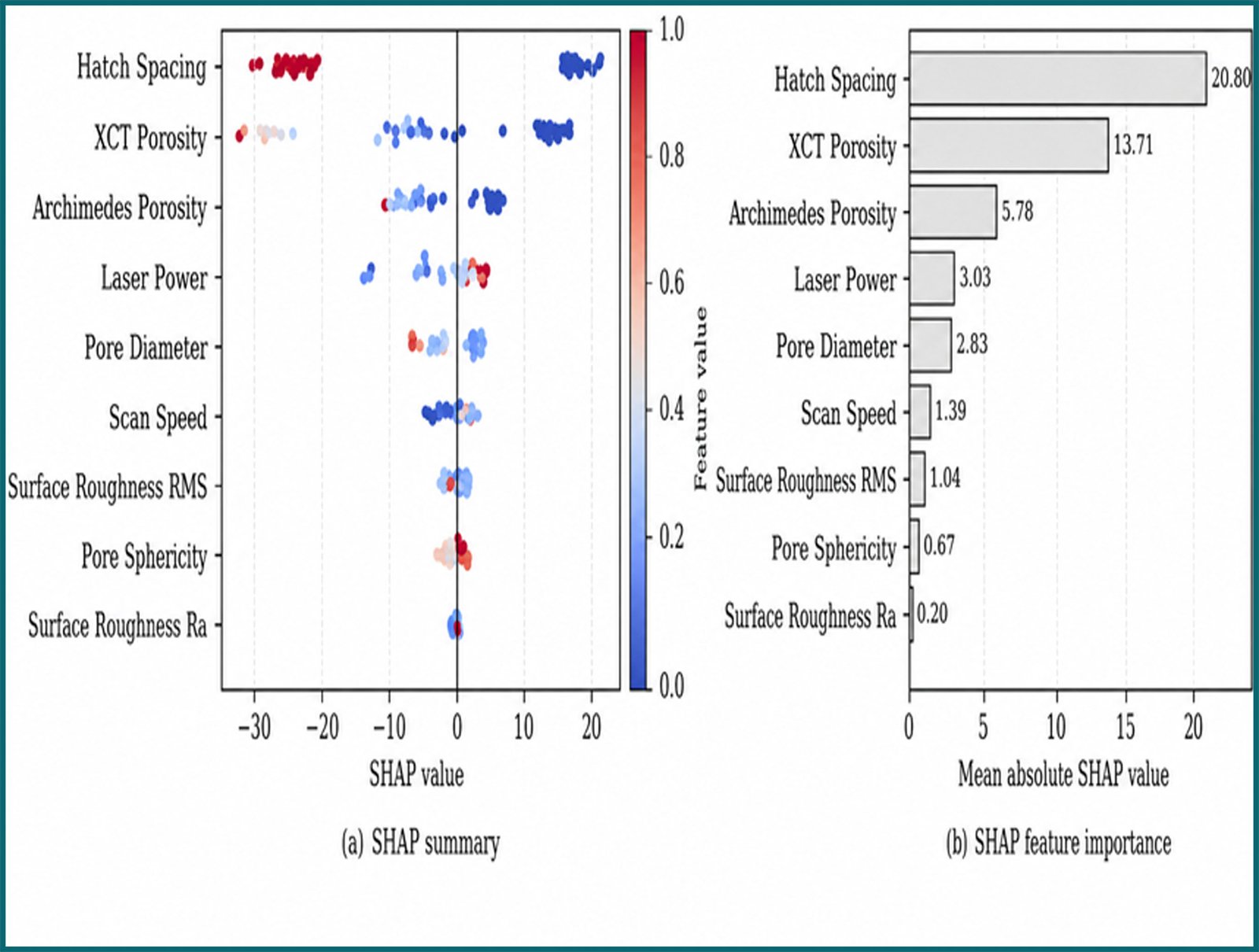
The mechanical properties of AlSi10Mg fabricated by the Laser Powder Bed Fusion (LPBF) process are strongly influenced by processing parameters and the microstructural characteristics developed during fabrication. However, the relationships among process parameters, defect formation, and mechanical responses are highly complex and difficult to explain using conventional statistical approaches. This study aims to investigate the sensitivity of process parameters and microstructural characteristics on the mechanical performance of AlSi10Mg using a combination of Random Forest and SHapley Additive exPlanations (SHAP) approaches. The input variables include laser power, scan speed, hatch spacing, porosity, pore characteristics, and surface roughness, while yield strength and ultimate tensile strength are used as prediction targets. The developed Random Forest models achieved coefficients of determination (R²) of 0.645 for yield strength and 0.640 for ultimate tensile strength, indicating satisfactory predictive capability. SHAP analysis revealed that porosity-related variables contributed most significantly to variations in mechanical properties. XCT porosity was identified as the most influential parameter affecting yield strength, with a mean absolute SHAP value of 10.87, whereas hatch spacing exhibited the highest contribution to ultimate tensile strength, with a value of 20.80. The findings indicate that the influence of process parameters on mechanical properties is not direct but is mediated through changes in densification quality and defect formation during the fabrication process
References
[1] Dejene, N. D., & Lemu, H. G. (2023). Current Status and Challenges of Powder Bed Fusion-Based Metal Additive Manufacturing: literature review. Metals, 13(2), 424.
[2] Zhou, L., Miller, J., Vezza, J., Mayster, M., Raffay, M., Justice, Q., ... & Bernat, J. (2024). Additive Manufacturing: A Comprehensive Review. Sensors, 24(9), 2668.
[3] Giovagnoli, M., Silvi, G., Merlin, M., & Di Giovanni, M. T. (2021). Optimisation of Process Parameters for an Additively Manufactured Alsi10mg Alloy: Limitations of The Energy Density-Based Approach on Porosity and Mechanical Properties Estimation. Materials Science and Engineering: A, 802, 140613.
[4] Šolić, S., Sakač, I., Tropša, V., & Šercer, M. (2024). Influence of The Lpbf Process Parameters on The Porosity of The Alsi10mg Alloy. Tehnički glasnik, 18(1), 87-91.
[5] Calignano, F., Cattano, G., & Manfredi, D. (2018). Manufacturing of Thin Wall Structures in Alsi10mg Alloy by Laser Powder Bed Fusion Through Process Parameters. Journal of Materials Processing Technology, 255, 773-783.
[6] Mishra, A. K., & Kumar, A. (2024). Effect of Process Parameters on Melt Pool Characteristics and Solidification Process During Laser Powder Bed Fusion of AlSi10Mg Alloy. Lasers in Manufacturing and Materials Processing, 11(2), 260-283.
[7] Leni, D., Karudin, A., Abbas, M. R., Sharma, J. K., & Adriansyah, A. (2024). Optimizing Stainless Steel Tensile Strength Analysis: Through Data Exploration and Machine Learning Design with Streamlit. EUREKA: Physics and Engineering, (5), 73-88.
[8] Leni, D., Sumiati, R., Haris, H., Karudin, A., Kusuma, Y. P., & Afriyani, S. (2026, January). Application of Machine Learning Algorithms for Predicting Mechanical Properties of Stainless Steel. In AIP Conference Proceedings (Vol. 3337, No. 1, p. 040004). AIP Publishing LLC.
[9] Leni, D., Utami, L. P., Berli, A. U., Adriansyah, & Haris. (2025, January). Feature Selection with Information Gain in Machine Learning Modeling for Predicting Low-Alloy Steel Mechanical Properties. In AIP Conference Proceedings (Vol. 3223, No. 1, p. 020023). AIP Publishing LLC.
[10] Anjum, M., Khan, K., Ahmad, W., Ahmad, A., Amin, M. N., & Nafees, A. (2022). New Shapley Additive Explanations (Shap) Approach to Evaluate The Raw Materials Interactions of Steel-Fiber-Reinforced Concrete. Materials, 15(18), 6261.
[11] Wang, Z., Liu, H., Amin, M. N., Khan, K., Qadir, M. T., & Khan, S. A. (2024). Optimizing Machine Learning Techniques and Shapley Additive Explanations (Shap) Analysis for The Compressive Property of Self-Compacting Concrete. Materials Today Communications, 39, 108804.
[12] Luo, Q., Huang, N., Fu, T., Wang, J., Bartles, D. L., Simpson, T. W., & Beese, A. M. (2024). Dataset of Process-Structure-Property Feature Relationships for Alsi10mg Material Fabricated Using Laser Powder Bed Fusion Additive Manufacturing. Data in Brief, 53, 110130.
[13] Maimuzar, m., Hendra, h., Khan, S., Leni, D., & Islahuddin, i. (2024). Optimizing rediction of stainless steel mechanical properties with random forest: a comparison of feature selection methods. JURNAL POLIMESIN : Politeknik Negeri Lhokseumawe, 22(5), 498.
[14] Kwak, S., Kim, J., Ding, H., Xu, X., Chen, R., Guo, J., & Fu, H. (2022). Machine Learning Prediction of The Mechanical Properties of Γ-Tial Alloys Produced Using Random Forest Regression Model. Journal of Materials Research and Technology, 18, 520-530.
[15] Utami, L. P., Armijal, A., Leni, D., & Kasmar, A. F. (2025). Prediction of Aluminum Alloy Mechanical Properties Using Synthetic Data Generated by Generative Adversarial Networks. Jurnal Polimesin, 23(2), 159-168.
[16] Leni, D., Kesuma, D. S., Maimuzar, Haris, & Afriyani, S. (2024). Prediction of Mechanical Properties of Austenitic Stainless Steels with The Use of Synthetic Data Via Generative Adversarial Networks. Engineering Proceedings, 63(1), 4.
[17] Spierings, A. B., Herres, N., & Levy, G. (2011). Influence of The Particle Size Distribution on Surface Quality and Mechanical Properties in Am Steel Parts. Rapid Prototyping Journal, 17(3), 195–202. https://doi.org/10.1108/13552541111124770
[18] Read, N., Wang, W., Essa, K., & Attallah, M. M. (2015). Selective Laser Melting of Alsi10mg Alloy: Process Optimisation and Mechanical Properties Development. Materials & Design, 65, 417–424. https://doi.org/10.1016/j.matdes.2014.09.044
[19] Hyer, H., Zhou, L., Park, S., Gottsfritz, G., Benson, G., Tolentino, B., ... & Sohn, Y. (2020). Understanding The Laser Powder Bed Fusion of AlSi10Mg Alloy. Metallography, Microstructure, and Analysis, 9(4), 484-502.
[20] Wang, A., Wei, Q., Tang, Z., Oliveira, J. P., Leung, C. L. A., Ren, P., ... & Wang, H. (2024). Effects of Hatch Spacing on Pore Segregation and Mechanical Properties During Blue Laser Directed Energy Deposition of AlSi10Mg. Additive Manufacturing, 85, 104147.
Downloads
Published
Issue
Section
License
Copyright (c) 2026 Yuda Perdana Kusuma, Desmarita Leni, Yuli Yetri, Nurul Qolbi, Junaidi Junaidi

This work is licensed under a Creative Commons Attribution 4.0 International License.