Structural Assessment of a Sand-Cast Aluminum Pulley Under Radial Loading Using Finite Element Analysis
DOI:
https://doi.org/10.67795/ijamset.v1i1.6Keywords:
Aluminum pulley, sand casting , structural analysis, finite element analysis, ; Von Mises stressAbstract
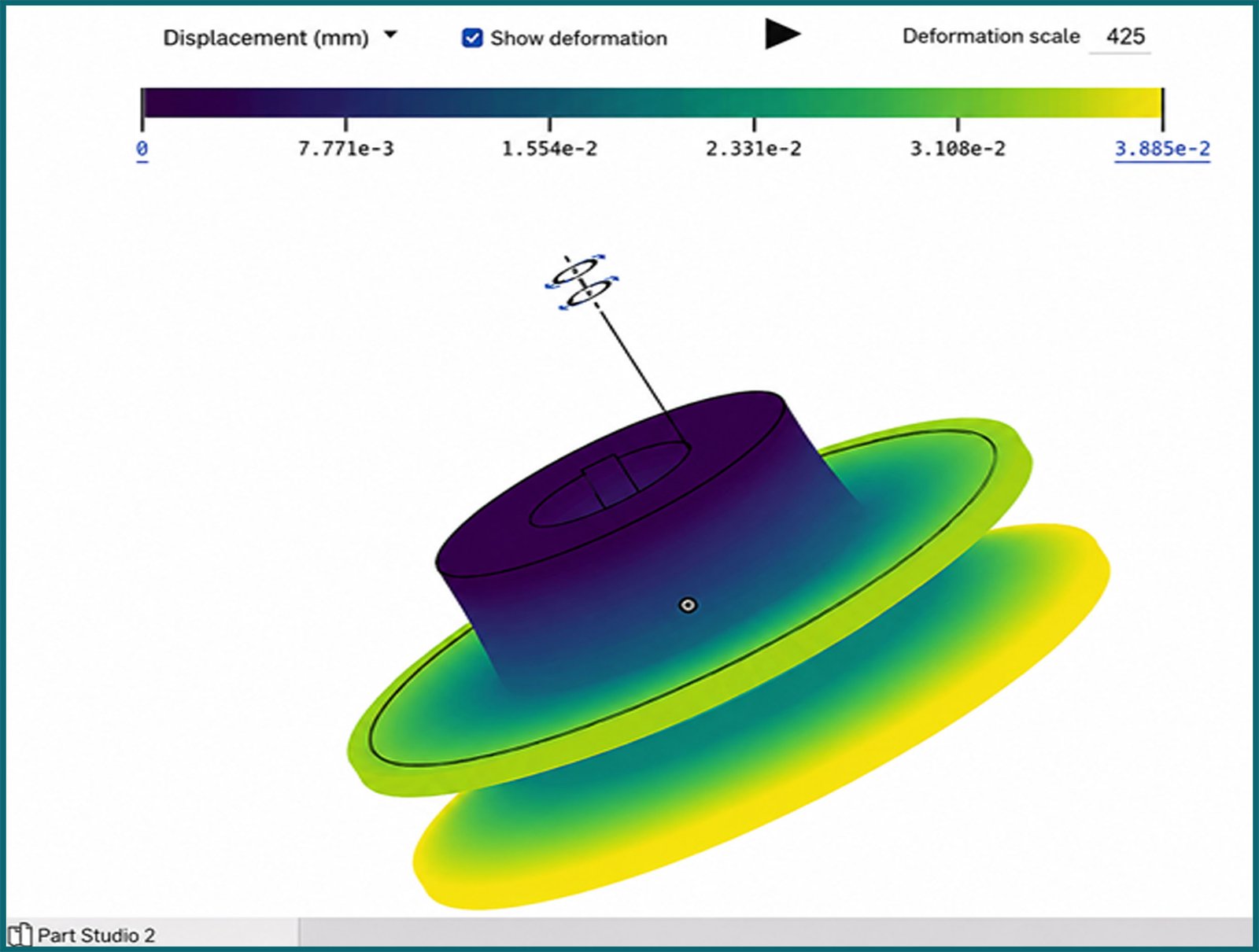
A pulley is one of the essential components in a power transmission system and must possess adequate structural strength to withstand operational loads. This study aims to analyze the structural behavior of a sand-cast aluminum pulley under various radial loading conditions using the Finite Element Analysis (FEA) method. The research procedure consisted of observing the sand-casting process, measuring the actual dimensions of the pulley, developing a three-dimensional model using Onshape, assigning material properties, and performing structural simulations under radial loads of 100 N, 200 N, and 300 N. The analyzed parameters included Von Mises stress, total deformation, and safety factor. The simulation results revealed that increasing the applied load resulted in a linear increase in both stress and deformation. The maximum Von Mises stress increased from 68.85 MPa under a 100 N load to 206.50 MPa under a 300 N load, while the maximum deformation increased from 0.01943 mm to 0.05828 mm. The highest stress concentration was observed in the keyway region of the pulley hub, whereas the maximum deformation occurred at the outer edge of the flange. A minimum safety factor of 3.5 indicated that the pulley structure remained within a safe operating condition up to a radial load of 300 N. The findings demonstrate that the sand-cast aluminum pulley exhibits satisfactory structural performance and is suitable for operation within the analyzed loading range.
References
[1] H. Peng et al., “Review of Failure Mechanisms of Steel Wire Ropes Under Heavy-Load Conditions and the Anti-Friction Effects of Gel-like Grease,” Gels, vol. 11, no. 11, p. 900, Nov. 2025, doi: 10.3390/gels11110900.
[2] E. W. A. Fanani, E. Surojo, A. R. Prabowo, and H. I. Akbar, “Recent Progress in Hybrid Aluminum Composite: Manufacturing and Application,” Metals, vol. 11, no. 12, p. 1919, Nov. 2021, doi: 10.3390/met11121919.
[3] P. K. Mallick, Ed., Materials, Design and Manufacturing for Lightweight Vehicles, Second edition. in Woodhead Publishing series in materials. Oxford: Woodhead Publishing, an imprint of Elsevier, 2021.
[4] C. K. Chan et al., “Development and Implementation of an Automated Cattle Feeding System using Cost-Effective Automation Techniques,” Eng. Sci., 2026, doi: 10.30919/es2262.
[5] J. M. Pujara, R. L. Patel, J. K. Dadhaniya, K. K. Dave, H. N. Jani, and D. R. Bhatti, “Investigating Deformation and Stress Distribution in Ball Bearings Using Finite Element Analysis,” SSRG-IJME, vol. 11, no. 8, pp. 109–121, Aug. 2024, doi: 10.14445/23488360/IJME-V11I8P113.
[6] W. Jiang, Ed., Analysis and Design of Machine Elements, 1st ed. Wiley, 2019. doi: 10.1002/9781119276081.
[7] A. Akhtar Khan et al., “Structural analysis of cotton stalk Puller and Shredder Machine,” Alexandria Engineering Journal, vol. 64, pp. 335–347, Feb. 2023, doi: 10.1016/j.aej.2022.09.002.
[8] K. R. Kashyzadeh and N. G. Bogale, “Simulation-based Optimization of Molten Pool Position in Sand Casting of a Complex Steering Knuckle Geometry,” Procedia Structural Integrity, vol. 79, pp. 65–72, 2026, doi: 10.1016/j.prostr.2025.12.308.
[9] D. A. Yeshanew, B. Tolessa, and B. Singh, “Experimental Investigation and Optimization of Reclaimed Sand-Casting Parameters for The Aluminum Alloy Easting Process,” Discov Mater, vol. 6, no. 1, p. 81, Feb. 2026, doi: 10.1007/s43939-026-00546-1.
[10] F. Ferroudji, C. Khelifi, F. Meguellati, and K. Koussa, “Design and Static Structural Analysis of a 2.5 kW Combined Darrieus-Savonius Wind Turbine,” JERA, vol. 30, pp. 94–99, May 2017, doi: 10.4028/www.scientific.net/JERA.30.94.
[11] S. O. Afolabi, B. I. Oladapo, C. O. Ijagbemi, A. O. M. Adeoye, and J. F. Kayode, “Design and Finite Element Analysis of a Fatigue Life Prediction for Safe and Economical Machine Shaft,” Journal of Materials Research and Technology, vol. 8, no. 1, pp. 105–111, Jan. 2019, doi: 10.1016/j.jmrt.2017.10.007.
[12] X. Lai, S. Wang, Z. Guo, C. Zhang, W. Sun, and X. Song, “Designing a Shape–Performance Integrated Digital Twin Based on Multiple Models and Dynamic Data: A Boom Crane Example,” Journal of Mechanical Design, vol. 143, no. 7, p. 071703, Jul. 2021, doi: 10.1115/1.4049861.
[13] H. A. Musa and M. Q. Abdullah, “Influence of Using Asymmetric Teeth Profile on Stress Concentrations in Gear Key-way,” IOP Conf. Ser.: Mater. Sci. Eng., vol. 1094, no. 1, p. 012067, Feb. 2021, doi: 10.1088/1757-899X/1094/1/012067.
[14] I. T. Haider, M. Lee, R. Page, D. Smith, and W. B. Edwards, “Mechanical Fatigue of Whole Rabbit-tibiae Under Combined Compression-T Loading is Better Explained by Strained Volume than Peak Strain Magnitude,” Journal of Biomechanics, vol. 122, p. 110434, Jun. 2021, doi: 10.1016/j.jbiomech.2021.110434.
[15] S. Coemert, B. Yalvac, V. Bott, Y. Sun, and T. C. Lueth, “Development and Validation of an Automated FEM-Based Design Optimization Tool for Continuum Compliant Structures,” Int J Mech Mater Des, vol. 17, no. 2, pp. 245–269, Jun. 2021, doi: 10.1007/s10999-020-09506-w.
[16] Cipto, K. A. Rahangmetan, F. Sariman, Hariyanto, S. B. Bahar, and M. T. Sapsal, “Stress Analysis on The Frame of Peanut Skin Peeler Using Autodesk Inventor Software,” IOP Conf. Ser.: Earth Environ. Sci., vol. 343, no. 1, p. 012164, Oct. 2019, doi: 10.1088/1755-1315/343/1/012164.
[17] Z. Tian et al., “A New Method for Calculating the Setting Stress of Downhole Packer’s Inner Sleeve,” Processes, vol. 13, no. 5, p. 1593, May 2025, doi: 10.3390/pr13051593.
[18] W. Reffeor, “Using FEA as a Pedagogical Tool for Teaching Machine Component Design,” in 2018 ASEE Annual Conference & Exposition Proceedings, Salt Lake City, Utah: ASEE Conferences, Jun. 2018, p. 31205. doi: 10.18260/1-2--31205.
[19] A. Berardi, C. D. Dellisanti, D. Tarantino, K. S. Leheche Ouette, A. Leone, and A. Tamborrino, “FEA for Optimizing Design and Fabrication of Frame Structure of Elevating Work Platforms,” Applied Sciences, vol. 15, no. 13, p. 7356, Jun. 2025, doi: 10.3390/app15137356.
[20] L. I. W. Arnouts, T. J. Massart, N. De Temmerman, and P. Z. Berke, “Computational Design of Bistable Deployable Scissor Structures: Trends and Challenges,” Journal of the International Association for Shell and Spatial Structures, vol. 60, no. 1, pp. 19–34, Mar. 2019, doi: 10.20898/j.iass.2019.199.031.
[21] V. Tuninetti, D. Martínez, S. Narayan, B. Menacer, and A. Oñate, “Design Optimization of a Marine Propeller Shaft for Enhanced Fatigue Life: An Integrated Computational Approach,” JMSE, vol. 12, no. 12, p. 2227, Dec. 2024, doi: 10.3390/jmse12122227.
[22] D. G. Ntritsos, A. D. Tsolakis, and K. I. Giannakopoulos, “Experimental and Analytical Approach of Fatigue Behavior of Stepped CK45 Shaft with Adjacent Key Groove,” Procedia Structural Integrity, vol. 10, pp. 288–294, 2018, doi: 10.1016/j.prostr.2018.09.040.
[23] K. Ntarladima, M. Pieber, and J. Gerstmayr, “A Model for Contact and Friction Between Beams Under Large Deformation and Sheaves,” Nonlinear Dyn, vol. 111, no. 22, pp. 20643–20660, Nov. 2023, doi: 10.1007/s11071-023-08973-y.
[24] Y. Vadila, R. Stevano, and R. P. Putra, “Numerical Analysis of Pressure and Velocity Distribution on NACA 0012 Airfoil Using Two CFD Computational Domains,” International Journal of Mechanical Engineering and Smart Technology, vol. 1, no. 1, pp. 41–52, 2026.
Downloads
Published
Issue
Section
License
Copyright (c) 2026 Mulyadi Mulyadi, Dadi Budiman, Habib Putra Fadel, Nofriadi Nofriadi , Muh Anhar

This work is licensed under a Creative Commons Attribution 4.0 International License.