Analysis of the Effects of Fused Deposition Modeling 3D Printing Process Parameters on the Tensile Strength of Thermoplastic Materials
DOI:
https://doi.org/10.67795/ijamset.v1i1.7Keywords:
Fused Deposition Modeling, tensile strength, PLA, ABS, PETGAbstract
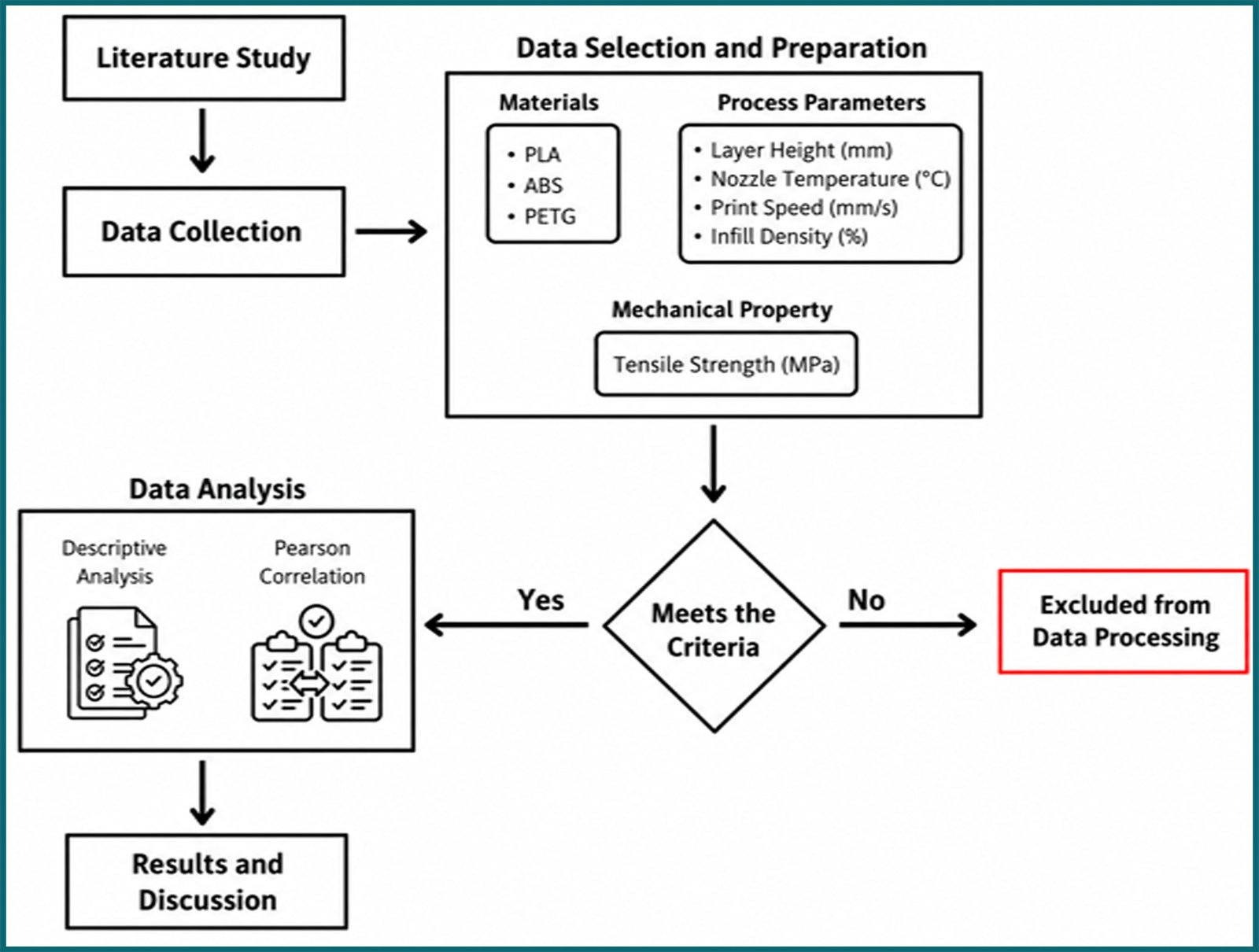
Fused Deposition Modeling (FDM) is one of the most widely used additive manufacturing technologies; however, the effects of process parameters on tensile strength are still often investigated separately for each material. This study aims to analyze and compare the effects of layer height, nozzle temperature, print speed, and infill density on the tensile strength of PLA, ABS, and PETG materials within a uniform analytical framework. The research data were obtained through the compilation of 96 experimental data points from 11 scientific publications, with each material represented by 32 data points. The analysis was conducted using descriptive statistics and Pearson correlation at a significance level of 5%. The results showed that PLA had the highest average tensile strength of 48.65 MPa, followed by PETG at 32.98 MPa and ABS at 21.41 MPa. For PLA, infill density showed the strongest and most significant relationship with tensile strength, followed by print speed and nozzle temperature. For PETG, nozzle temperature was the only parameter that showed a significant relationship and the highest correlation compared with the other parameters. In contrast, all parameters analyzed for ABS did not show statistically significant relationships, indicating that the tensile strength of ABS is more influenced by other factors such as printing orientation and raster angle, which are beyond the scope of this study. These findings indicate that the response of materials to FDM process parameters is material-dependent; therefore, process parameter optimization strategies need to be adjusted according to the characteristics of each material to achieve optimal tensile strength.
References
[1]. Zhou, L., Miller, J., Vezza, J., Mayster, M., Raffay, M., Justice, Q., ... & Bernat, J. (2024). Additive Manufacturing: a Comprehensive Review. Sensors, 24(9), 2668.
[2]. Țisari, V., Mihalache, M. A., Nagîț, G., Ermolai, V., Irimia, A. I., Grădinaru, C. G., ... & Slătineanu, L. (2026). The Influence of Certain Operating Conditions of the FDM Process on the Mechanical Properties of Polymeric Materials A Review. Polymers, 18(10), 1183.
[3]. Megersa, G. K., Sitek, W., Nowak, A. J., & Tomašić, N. (2024). Investigation of the Influence of Fused Deposition Modeling 3D Printing Process Parameters on Tensile Properties of Polylactic Acid Parts Using The Taguchi Method. Materials, 17(23), 5951.
[4]. Sultan, M. M., Aized, T., Farooq, M., Anwar, S., Ahmad, N., Tauseef, A., & Riaz, F. (2025). Optimization of PETG 3D Printing Parameters for The Design and Development of Biocompatible Bone Implants. Frontiers in Bioengineering and Biotechnology, 13, 1549191.
[5]. Leni, D., Rosa, Y., Sunitra, E., Muharni, R., & Kusuma, Y. P. (2026). Analysis of the Effect of Fused Deposition Modeling Process Parameters on the Tensile Strength of PLA Material. International Journal of Mechanical Engineering and Smart Technology, 1(1), 53-61
[6]. Dizon, J. R. C., Espera Jr, A. H., Chen, Q., & Advincula, R. C. (2018). Mechanical Characterization of 3D-Printed Polymers. Additive manufacturing, 20, 44-67.
[7]. Popescu, D., Zapciu, A., Amza, C., Baciu, F., & Marinescu, R. (2018). FDM Process Parameters Influence over The Mechanical Properties of Polymer Specimens: A review. Polymer Testing, 69, 157-166.
[8]. Plamadiala, I., Croitoru, C., Pop, M. A., & Roata, I. C. (2025). Enhancing Polylactic Acid (PLA) Performance: a Review of Additives in Fused Deposition Modelling (FDM) Filaments. Polymers, 17(2), 191.
[9]. Eyri, B., Gul, O., Yilmaz, S., Karsli, N. G., & Yilmaz, T. (2025). Characterization of ABS/PETG Multi‐Material Composites 3D Printed by Print‐Pause‐Print Method. Polymer Engineering & Science, 65(5), 2353-2369.
[10]. Aslan, E., Akıncıoğlu, G., & Şirin, E. (2025). A Comparative Study on Friction Performance and Mechanical Properties of Printed PETG Materials with Different Patterns. Journal of Applied Polymer Science, 142(27), e57136.
[11]. Hong Vi, N., Chuong, C. K. B., My, L. T. T., Hieu, D. H. M., & Thanh, T. T. (2022, November). Effects of Infill Density, Layer Thickness and Raster Angle on Weight and Tensile Strength of PLA Products Fabricated by Fused Deposition Modeling (FDM). In International Conference on Material, Machines and Methods for Sustainable Development (pp. 87-98). Cham: Springer Nature Switzerland.
[12]. Albaşkara, M., & Yıldız, İ. (2025). A Comparative Study On The Tensile Properties Of Pla, Petg, and ABS in FDM 3D Printing: Effects of Infill Geometry and Build Orientation. International Journal of 3D Printing Technologies and Digital Industry, 9(3), 688-697.
[13]. Leni, D., Sumiati, R., Haris, H., Karudin, A., Kusuma, Y. P., & Afriyani, S. (2026, January). Application of Machine Learning Algorithms for Predicting Mechanical Properties of Stainless Steel. In AIP Conference Proceedings (Vol. 3337, No. 1, p. 040004). AIP Publishing LLC.
[14]. Ekşi, S., & Karakaya, C. (2025). Effects of Process Parameters on Tensile Properties of 3D-Printed PLA Parts Fabricated with The FDM Method. Polymers, 17(14), 1934.
[15]. Ali, H. B., Oleiwi, J. K., & Othman, F. M. (2022). Compressive and Tensile Properties of ABS Material as a Function of 3D Printing Process Parameters. Revue des composites et des matériaux avancés, 32(3), 117.
[16]. Awad, A. H., Sayed, R. A. E., & Atef, M. (2025, October). Enhancing Mechanical Properties of PETG by Optimization of Process Parameters Using The Taguchi Method. In The International Conference on Applied Mechanics and Mechanical Engineering (Vol. 22, No. 22, pp. 1-11). Military Technical College.
[17]. Chen, D. C., Zheng, Q. D., & Chen, C. H. (2024). Optimization of Tensile Strength and Cost-Effectiveness of Polyethylene Terephthalate Glycol in Fused Deposition Modeling Using the Taguchi Method and Analysis of Variance. Polymers, 16(22), 3133.
[18]. Khusheef, A. S., Hashemi, R., & Shahbazi, M. (2024). Optimizing FDM Process Parameters: Predictive Insights Through Taguchi, Regression, and Neural Networks. Physica Scripta, 99(6), 066005.
[19]. Winarso, R., Hidayat, T., Gunawan, B., Nugraha, F., & Mulyani, S. (2026). Preliminary Prototyping and Parameter Optimization of FDM-Based Custom Bone Plates: A Feasibility Study For Orthopedic Fixation. International Journal on Interactive Design and Manufacturing (IJIDeM), 1-20.
[20]. Mishra, V., Bharat, N., Kumar, V., Veeman, D., & Vellaisamy, M. (2024). Assessment of Physio-Mechanical Characteristics of Abs/Petg Blended Parts Fabricated by Material Extrusion 3D Printing. Physica Scripta, 99(12), 125033.
[21]. Rodríguez-Panes, A., Claver, J., & Camacho, A. M. (2018). The Influence of Manufacturing Parameters on The Mechanical Behaviour of Pla and ABS Pieces Manufactured by FDM: A Comparative Analysis. Materials, 11(8), 1333.
[22]. Saini, M. (2019). Optimization The Process Parameter of Fdm 3D Printer Using Taguchi Method for Improving The Tensile Strength. Int. J. All Res. Educ. Sci. Methods, 7, 16-24.
[23]. Ulkir, O., Ertugrul, I., Ersoy, S., & Yağımlı, B. (2024). The Effects of Printing Temperature on The Mechanical Properties of 3D-Printed Acrylonitrile Butadiene Styrene. Applied Sciences, 14(8), 3376.
[24]. Zakaria, S., Stighfarrinata, R., & Maghfiroh, A. M. R. (2022). Optimasi Parameter Proses 3D Printing Terhadap Kuat Tarik Filament PETG Menggunakan Metode Taguchi. JUSTI (Jurnal Sistem Dan Teknik Industri), 3(4), 538-545.
[25]. Gaal, G., Gaal, V., Braunger, M. L., Riul Jr, A., & Rodrigues, V. (2020). FDM 3D Printing in Biomedical and Microfluidic Applications. In 3D Printing in Biomedical Engineering (pp. 127-145). Singapore: Springer Singapore.
[26]. Ahn, S. H., Montero, M., Odell, D., Roundy, S., & Wright, P. K. (2002). Anisotropic Material Properties of Fused Deposition Modeling ABS. Rapid prototyping journal, 8(4), 248-257.
[27]. Kopar, M., & Yildiz, A. R. (2023). Experimental Investigation of Mechanical Properties of PLA, ABS, and PETG 3D Printing Materials Using Fused Deposition Modeling Technique. Materials Testing, 65(12), 1795-1804.
[28]. Mardlotila, M. J., Trifiananto, M., Dwilaksana, D., Basuki, H. A., Kustanto, M. N., & Hardiatama, I. (2022). Effect of Layer Height, Infill Geometry, Nozzle Temperature, and Fan Speed on Tensile Strength of 3D Printing Petg Specimens. INVOTEK: Jurnal Inovasi Vokasional Dan Teknologi, 22(3), 149-158.
[29]. Zeng, Y. S., Hsueh, M. H., Lai, C. J., Fang, T. H., Hsieh, T. H., & Lin, T. K. (2025). Mechanical Behavior of Fdm-Printed Petg Under Temperature–Speed Coupling and Sequential Annealing/Uv: Implications for Process Design. Journal of Reinforced Plastics and Composites, 07316844251414909.
[30]. Dolzyk, G., & Jung, S. (2019). Tensile and Fatigue Analysis of 3D-Printed Polyethylene Terephthalate Glycol. Journal of Failure Analysis and Prevention, 19(2), 511-518.
[31]. Gültekin, M. Ş. (2026). Prediction of Tensile Strength of Pla Parts Produced With Fdm Using Taguchi L27, Anova, and Large-Scale Machine Learning Models and Optimal Parameter Design. Journal of Thermoplastic Composite Materials, 08927057261429023.
[32]. Agrawal, A. P., Kumar, V., Kumar, J., Paramasivam, P., Dhanasekaran, S., & Prasad, L. (2023). An Investigation of Combined Effect of Infill Pattern, Density, and Layer Thickness on Mechanical Properties of 3D Printed ABS by Fused Filament Fabrication. Heliyon, 9(6).
Downloads
Published
Issue
Section
License
Copyright (c) 2026 Yuanda Perdana Kusuma, Dedi Wardianto, Yuni Vadila

This work is licensed under a Creative Commons Attribution 4.0 International License.